

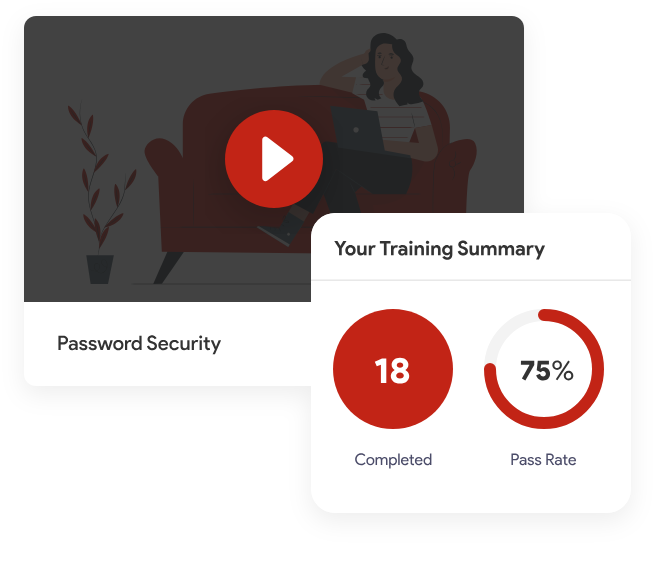
Cyber Security Training with Phishing Simulations
Help your team recognise and avoid cyber threats with practical training and real-world phishing simulations.

Most cyber attacks do not break in, they are let in
Phishing emails, suspicious links, fake invoices, and social engineering attacks are designed to look legitimate. Without the right awareness, it is easy for staff to make mistakes that could lead to a serious security issue. Our cyber security training helps your team understand what threats look like in the real world, how to respond when something seems suspicious, and why their actions matter. It is not about blaming users. It is about giving them the confidence to spot risks before they become problems.Training that builds awareness over time
Cyber awareness works best when it is practical, regular, and easy for staff to engage with.
Short, practical training
Staff complete simple training sessions designed to explain common threats in plain English.
Phishing simulations
Realistic phishing emails are sent to test awareness and help users understand what to look for.
Results and visibility
You can see how users respond, where risks appear, and where extra guidance may be needed.
Ongoing improvement
Training is reinforced over time, helping awareness become part of everyday behaviour.
Helping your team spot the threats they see every day
Most people do not fall for cyber attacks because they are careless. They fall for them because modern threats are designed to look convincing.
Helping staff become more aware of cyber risks
For Wheelers Accountants, cyber awareness training was implemented alongside 24/7 MDR and SOC monitoring to help strengthen their overall security.

“It has made staff much more aware of emails, particularly those that might not be legitimate.”
Helen Garrett, Partner
Training works best alongside proper protection
Cyber awareness training is important, but it should not be your only line of defence. It works best as part of a joined-up cyber security approach.
Monitored security
24/7 MDR and SOC monitoring helps detect suspicious activity when something goes wrong.
Email protection
Filtering and anti-spam tools help reduce the number of harmful emails reaching users in the first place.
Multi-factor authentication
MFA adds an extra layer of protection if passwords are compromised.
Backup and recovery
Secure backups help reduce disruption if an incident affects files, accounts, or systems.
Training protects your people. Managed cyber security protects the wider business.
A practical approach to cyber awareness
We keep training simple, relevant, and focused on reducing real risk across your business.
Simple for staff
Training is clear and practical, without unnecessary technical detail.
Ongoing, not one-off
Awareness improves through regular reinforcement, not a single annual exercise.
Real-world simulations
Phishing simulations help test how users respond to realistic threats.
Part of wider protection
Training can sit alongside your managed cyber security, Microsoft 365 protection, and device security.
Cyber security training questions
Clear answers to the questions businesses usually ask before introducing cyber awareness training.
What is cyber awareness training?
Cyber awareness training teaches staff how to recognise common threats such as phishing emails, suspicious links, password risks, and social engineering attempts.
Do you include phishing simulations?
Yes. Phishing simulations help test real-world behaviour and show where extra guidance may be needed.
Is this suitable for non-technical staff?
Yes. The training is designed to be clear, practical, and easy to understand for users across the business.
Is training enough on its own?
No. Training helps reduce human risk, but it works best alongside monitored security, email protection, MFA, backup, and device security.